


In which cases can dental implants be applied?
It should not be forgotten that our teeth are an organ that affects not only our chewing, but also our speech, appearance, and even personal charisma.
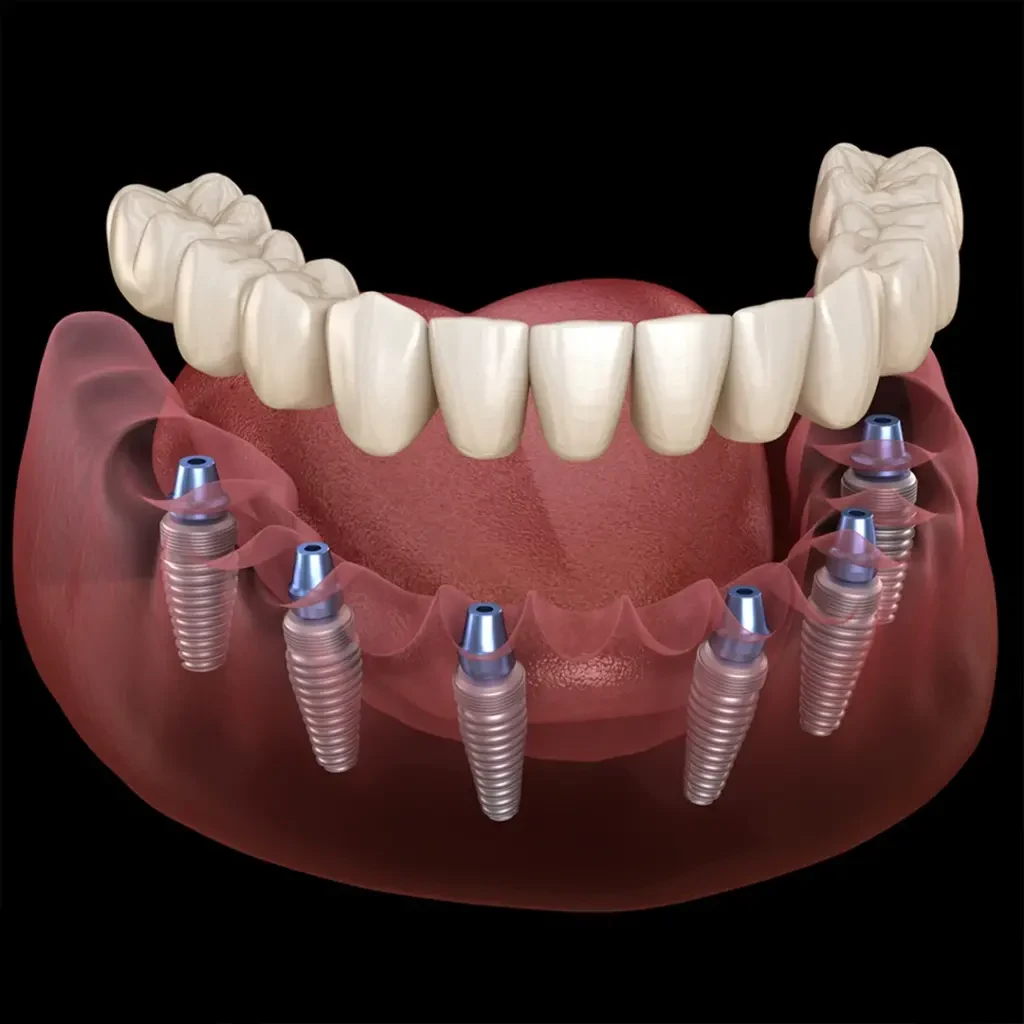
Dental implants can be applied in cases of single tooth deficiency, multiple tooth deficiencies, and complete edentulism.
Who is eligible for dental implants?
- Those who have a normal wound healing capacity,
- Those who have good oral hygiene and a healthy bone structure in sufficient quantity or with the potential to be brought to a sufficient quantity,
- Dental implants can be applied to anyone who does not have systemic diseases (diabetes mellitus, advanced osteoporosis, etc.) that pose an obstacle to the procedure.
What are the advantages of dental implant treatment?
An implant is a sturdy, comfortable, and reliable application. The prostheses placed on implants create the most natural structure while replacing real teeth. During the process of replacing missing teeth, healthy teeth are left untouched. The fact that our sound teeth are not cut down for the purpose of making a prosthesis is, of course, a very significant advantage. Furthermore, implants have a much longer lifespan compared to other prosthetic options.
Especially for our patients who have lost the chance to use fixed prostheses due to tooth loss, or patients complaining that their total prostheses do not stay fixed in their mouths due to bone resorption, implant treatment will be the first alternative that comes to mind.
Indeed, human life expectancy extending due to the development of living standards has led many of us to demand a certain living comfort in advanced ages as well. Again, using removable prostheses from a young age is certainly not something any of us would desire. Exactly at this point, implants offer us a great treatment alternative.
The effects of tooth loss are physiological as well as psychological. As a special application replacing the natural tooth, the implant also offers a definitive and healthy solution to the physiological and psychological problems caused by tooth loss or congenital missing teeth.
What is Oral Implantology?
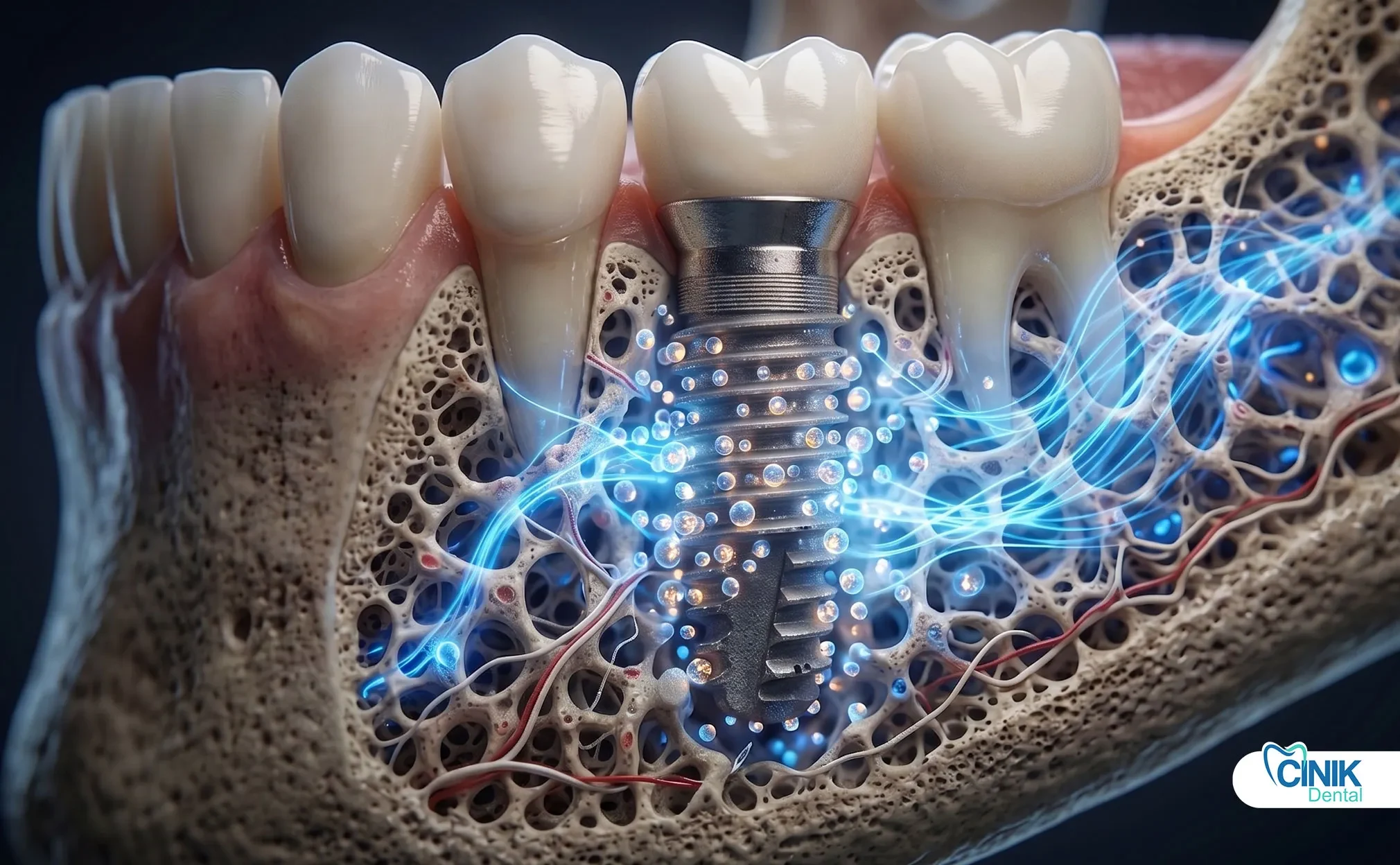
Plates, screws, and pins made of titanium, which are placed for therapeutic purposes in place of lost teeth, have no side effects for the organism, and can function like a natural tooth after completing their integration with the bone tissue, are called implants.
The tooth made on an implant looks like your natural tooth and exhibits natural performance.
Implants are an application dating back as far as human history. In various periods of history, people have seen mounting pieces onto the jawbone to serve as teeth as a solution.
Today, the most commonly used metal as an implant material is titanium. Titanium is a metal with excellent tissue compatibility that has been safely used in many fields of medicine for centuries.
Shaped into roots, cylinders, or screws, titanium is made ready for use as a dental implant after undergoing certain special procedures (special design acid-etching, laser roughening, etc.). These procedures determine the quality of the implant.
Physiologically occurring bone resorptions resulting from tooth loss or traumas cause a decrease in the level and volume of the jawbone. This situation prevents the prosthesis to be applied from fully performing its function. As a result, problems in chewing and speaking occur.
What are our treatment goals?
- The elimination of all types of edentulism and missing functions with implants and implant-supported prostheses.
- The replacement of a single missing tooth without touching the neighboring healthy teeth.
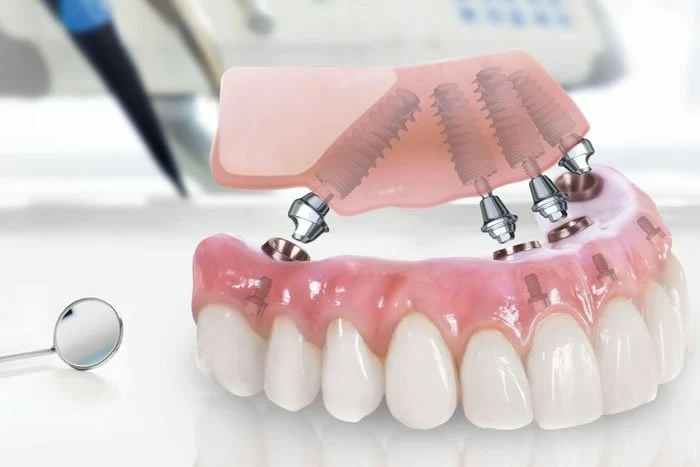
- The replacement of multiple missing teeth by making fixed bridges with the help of implants instead of removable prostheses.
- In cases of complete edentulism, it is not possible to make fixed prostheses instead of removable prostheses (dentures).
- Can implants be applied at any age?
- Yes. Only, bone development needs to be completed in young people. This occurs up to ages 16-17 in girls and 18 in boys.
- There is no upper age limit for adults. It can be applied to people of any age with an appropriate general health status. Since elderly people lose more teeth and experience resorption in their jawbones, they need dental implants more.
Are all dental implants successful?
For the success of implants, good general health—meaning a sufficient "healing potential"—accurate diagnosis, and proper cleaning and maintenance of the implant are required. In addition, appropriate surgery and a suitable prosthesis must be performed by the physician. Furthermore, heavy smoking and/or excessive alcohol consumption will negatively affect success. Depending on the aforementioned factors,
What is the lifespan of dental implants?
The first patients have been successfully using their implants for more than thirty years. This duration depends on several variables such as general health status, daily care, and cleaning of the implant. Still, as with any other medical intervention, in principle, while it is not possible to give a lifetime guarantee, implant success can range between 90-100%.
Situations where implant placement is not possible;
Placing implants may be contraindicated due to certain physical conditions or disabilities. These are:
- Advanced bone resorption
- Major heart conditions
- Blood clotting disorders
- Rheumatic diseases
- Extreme frailty and similar conditions
- In patients with diabetes (diabetes mellitus); uncontrolled cases where diabetes is not well-regulated
- Unsuitable, insufficient, or anatomically risky bone structure in the jaw
- Patient's unsuitability for surgical procedures (excessive fear, anxiety)
- Patient's financial constraints (Being an expensive procedure)
- Situations where the patient cannot fully maintain oral hygiene (oral cleaning) after the implant.
What if the treatment fails?
The implant can be removed with a very simple procedure, and the site heals on its own.
Are implants rejected by the body?
Implants are mostly made of biocompatible materials called titanium. Since titanium is not a living material, it does not trigger an antigen-antibody reaction like heart and kidney transplantations do. Therefore, a "tissue rejection" cannot be mentioned.
Is there a risk of cancer?
There is not a single example in the world of medicine and dentistry showing that dental implants cause cancer.
Are dental implants applied for cosmetic reasons?
The primary application area of dental implants is the replacement of missing teeth. While replacing missing teeth, cosmetic improvements can also be achieved.
Can a guarantee be given?
Scientific studies have shown that implant success varies between 90-100%. However, as with any medical intervention, it is not possible to guarantee implants. Nevertheless, in our clinic, the necessary conditions to increase treatment success are brought together with utmost care.
What are our main criteria determining our treatment success?
First of all, case selection, meaning making the correct diagnosis and indication, is the primary condition for treatment success.
- Correct prosthetic planning
- Appropriateness of clinical conditions (readiness of necessary surgical equipment and sterilization conditions)
- Demonstration of adequate surgical skill
- Preference for implant brands with proven clinical reliability based on years and a large number of cases.
- And maintaining the same care and skill while constructing the superstructure (implant-supported prosthesis).
- These are our main criteria that keep our treatment success high.
Is an implant an expensive treatment?
Implant procedures require a series of complex and long-term processes. Therefore, they also require higher expenditures than routine dental services. In a survey conducted with patients who completed their implant treatments, patients stated that they got their investment's worth and would have the same procedure done again if necessary.
Will I experience any discomfort during and after the operation?
The operation can be performed under local anesthesia and sedation without feeling any pain or discomfort. General anesthesia can also be applied when necessary. After the operation, there may be mild pain or swelling that might also be felt after any tooth extraction. These can be easily relieved with painkillers and necessary precautions.
How long does the placement operation and the completion of the prosthesis take?
The duration of the surgery can vary between half an hour and a few hours, depending on the number of implants to be placed and the patient's condition. After the operation, a waiting period of about 3-6 months is required for the implant to fuse with the bone (osseointegration). Afterward, prostheses are placed on these implants through an application lasting a few sessions.
Another option is active-surface implants, which can be applied by accepting a small cost difference. These new types of implants, which reduce the fusion (osseointegration) period to 2 weeks and thus allow for much quicker prosthesis fabrication, can be preferred depending on our patients' time constraints.
In cases where certain suitable conditions can be met, prostheses can also be made without any waiting period.
Utilizing all the possibilities of modern dentistry, these prostheses are engineering marvels.
Size özel reviews için randevu alın.
Okumaya devam edin.
 Diş Sağlığı RehberiZirkonyum Diş Kaplama Nedir? Uygulama Süreci, Avantajları ve BakımıRead More ↗
 Diş Sağlığı RehberiAll‑on‑6 İmplant Planlaması: Dijital TaramaRead More ↗
 Diş Sağlığı RehberiKök Hücre Tabanlı Periodontal Rejenerasyon ve All‑on‑6 İmplantRead More ↗
 Diş Sağlığı RehberiDijital Çalışma Akışıyla Kişiselleştirilmiş All‑on‑4Read More ↗